
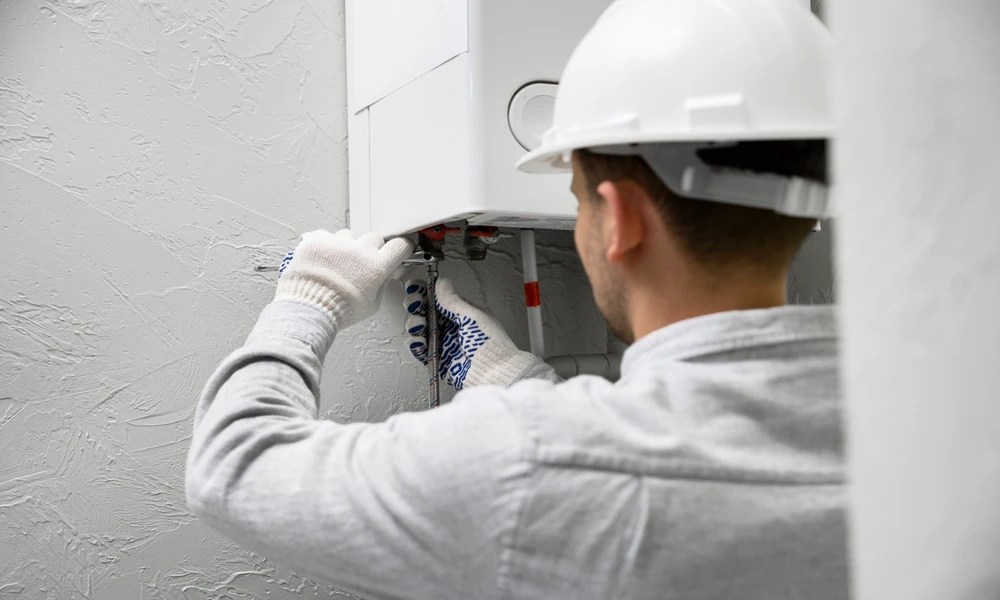

Your tank water heater is 11 years old, it’s sitting in a corner of the basement taking up four square feet, and you’re pretty sure the pilot light situation is getting sketchy. Sound familiar? Millions of Ohio homeowners hit this exact crossroads every year, and the question is always the same: fix what you have, drop in another tank, or finally make the jump to tankless?
The honest answer is that tankless is usually the smarter long-term call, but the math does depend on a few things specific to your home. Here’s what actually moves the needle.
What “On-Demand” Actually Means in Practice
A traditional tank heater keeps 40 to 50 gallons of water hot around the clock. That’s true at 2 a.m. on a Tuesday when no one’s awake, true when you’re on a two-week vacation, and true when the outside temp in Youngstown drops to single digits and your basement is running cold. All that pre-heated water bleeds heat through the tank walls constantly, and the burner keeps cycling back on to compensate. That waste has a name: standby loss.
A tankless unit does none of that. Cold water sits in a pipe at rest. The moment you open a hot-water tap, water flows through a heat exchanger, gets flash-heated to your set temperature, and arrives at the faucet. The second you close the tap, energy use drops to nearly zero. No storage, no standby loss, no reheating an empty house.
That design difference is why the U.S. Department of Energy reports that tankless water heaters are 24% to 34% more energy-efficient than conventional storage-tank units in homes using 41 gallons or fewer of hot water per day. Even households that use a lot of hot water, around 86 gallons daily, still see an 8% to 14% efficiency gain. Those aren’t marketing numbers. That’s measured performance data from the federal agency that sets appliance efficiency standards.
The Ohio Cold-Inlet Problem (and Why It Matters More Here)
Here’s a wrinkle most generic tankless articles gloss over: tankless units in Ohio have to work harder in winter than the same unit in Arizona.
A tankless heater’s job is to raise incoming water from ground temperature to your target temperature, usually 120°F. In the Sun Belt, ground water might arrive at 60°F to 65°F, so the unit needs to add 55 to 60 degrees. In northeast Ohio, incoming water in January often runs around 40°F to 45°F, meaning your unit is doing 75 to 80 degrees of work instead. That demands a higher BTU rating than you’d need in a warmer climate.
This is the single most common sizing mistake homeowners make when they buy a tankless unit online and try to self-install. A 6.6 GPM gas unit that handles a four-person household beautifully in Nashville can leave you with lukewarm showers in February in Mahoning County. Sizing for local inlet temperatures is non-negotiable, and it’s exactly the kind of detail a licensed local plumber will catch before installation, not after.
Lifespan: Where the Real Financial Case Gets Made
Upfront, tankless units cost more. A whole-house gas tankless installation runs meaningfully higher than a straight tank swap, mainly because gas line upgrades and venting changes often come with it. Nobody should pretend otherwise.
But consider the time horizon. The U.S. Department of Energy puts the expected lifespan of most tankless units at more than 20 years. A conventional storage tank typically hits end-of-life in 10 to 15 years. So over a 20-year window, a tank-heater household may buy two units and pay two installation bills. A tankless household pays once and lives inside that window.
| Feature | Tank Water Heater | Tankless Water Heater |
|---|---|---|
| Standby energy loss | Continuous (standby loss) | None |
| Energy efficiency gain (low-use home) | Baseline | 24%-34% more efficient (DOE) |
| Typical lifespan | 10-15 years | 20+ years (DOE) |
| Hot water supply | Limited by tank size | Continuous while within flow rate |
| Space footprint | Large floor unit | Wall-mounted, compact |
What About Ohio Energy Costs?
Water heating is a heavier budget line than most people think. According to the U.S. Energy Information Administration’s 2020 Residential Energy Consumption Survey, water heating, lighting, and refrigeration together accounted for 25% of total annual home energy use across U.S. households. Water heating carries the biggest individual share of that group, making it one of the most productive places to improve efficiency.
Ohio natural gas prices track closely to Midwest averages, and most Youngstown-area homes run gas water heaters. Gas tankless units deliver the strongest payback of any configuration because gas is cheaper per BTU than electricity, and the efficiency gains compound over a long run time. If you’re on electric now, you’ll still see savings, just at a slower pace.
“Homes with larger hot water demand require more heating and more energy to save.” – American Council for an Energy-Efficient Economy (ACEEE), field research on tankless water heater performance across measured installations.
That’s the inverse of the usual sales pitch, and it’s honest: bigger households see larger absolute dollar savings even if the efficiency percentage is lower. A family of four running back-to-back showers every morning recovers their investment faster than a retired couple using moderate hot water. Know your usage pattern before you run the numbers.
The Ohio Homeowner Readiness Checklist
Before you commit to a tankless upgrade, work through these five checkpoints. If you hit a “no” on more than two, talk through the details with a plumber before assuming tankless is your best path.
- Gas line capacity: Tankless gas units typically require a larger diameter supply line than tank heaters. Does your current line support it?
- Venting configuration: Direct-vent and power-vent tankless units use different flue configurations than tank heaters. Your existing flue may or may not be compatible.
- Water hardness: Parts of the Mahoning Valley run moderately hard water. Hard water scales heat exchangers over time. A descaling plan, or a water softener upstream, is smart and extends unit life significantly.
- Flow rate demand: How many hot-water fixtures run simultaneously at your peak usage moment? That number drives the GPM rating you need, and BTU capacity for Ohio inlet temps.
- How long you plan to stay: Tankless pays off over time. If you’re staying 10-plus years, the case is strong. If you’re selling in two years, a tank swap may be the simpler play.
Getting Installation Right the First Time
A poorly sized or improperly vented tankless unit is worse than the tank it replaced. Cold sandwiches in the shower, pressure fluctuations when two fixtures run at once, or a carbon monoxide issue from a bad venting job are all real outcomes of cut-corner installs. This is not a project for general handymen or unlicensed contractors.
For Youngstown-area homeowners specifically, professional tankless water heater installation in Youngstown means working with a plumber who knows Mahoning County inlet temperatures, local code for gas line sizing, and the venting requirements for northeast Ohio homes that weren’t originally built with tankless systems in mind. That local knowledge is the gap between a unit that runs perfectly for 20 years and one that underperforms from day one.
The upgrade decision almost always comes down to time horizon and household size. Stay long, use a fair amount of hot water, and hire someone who knows what they’re doing locally. Do those three things, and tankless pays for itself. Skip any one of them, and the math gets murkier fast.

