
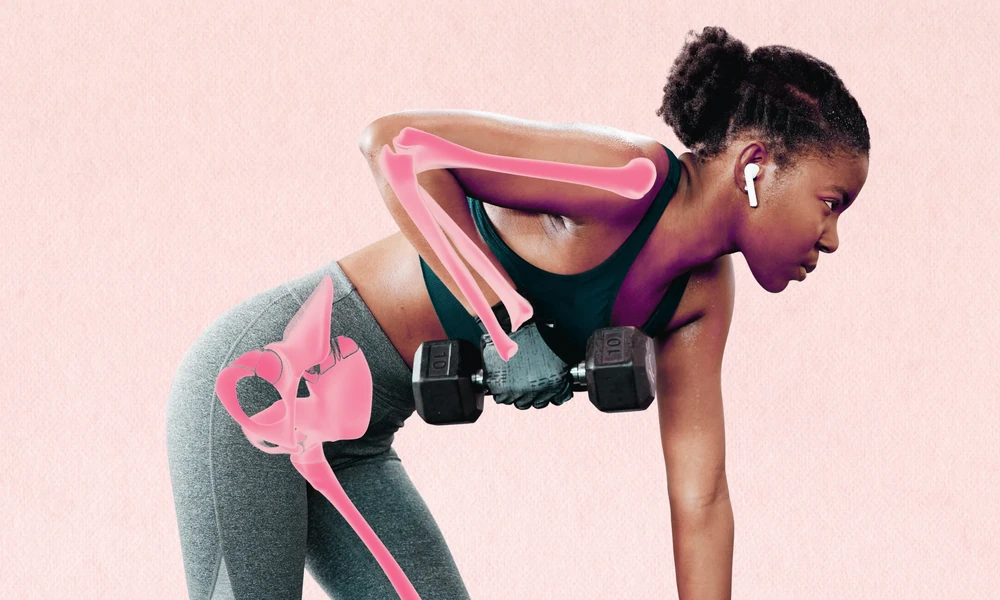

Twenty minutes a week. That is roughly how long one Minneapolis woman in her sixties spends on her bones now, down from the four gym visits she used to dread. She told me the numbers on her follow-up scan mattered less to her than the fact that she could carry groceries up her porch steps again without plotting the trip.
If you are in your fifties, sixties, or seventies and your last physical ended with a note about your bones, you have probably already been told to lift something heavy. That advice is correct. It is also vague enough to be useless. What kind of loading, how often, and how much soreness is normal are the questions nobody answers in a fifteen minute appointment.
Here is what this piece covers: the loading principle that drives bone response, why impact and resistance do different jobs, a way to judge any program before you pay for it, and what a realistic first six months looks like. No hype. Just the mechanics.
Bone responds to load, not to good intentions
Your skeleton is lazy in the smartest possible way. It adds material where it feels strain and strips material where it does not. That is why a sedentary decade shows up on a scan, and it is why swimmers, who work hard in the water, often have thinner bones than lifters. The water carries the load for them.
Two inputs drive the response. The first is magnitude, meaning a load heavy enough to bend the bone slightly. The second is rate, meaning how fast that force arrives. Stomp down a staircase and your tibia feels more than it does during a slow walk. Jump and you multiply it again.
According to the National Library of Medicine, weight bearing activity is one of the primary lifestyle factors that supports bone mass throughout adulthood. Notice the phrase weight bearing. A recumbent bike is kind to your knees and nearly useless for your hips.
This is why I get mildly irritated when people describe bone work as a senior stretching class. It is not stretching. It is mechanical engineering applied to a living structure.
Why impact and resistance do different jobs
People lump these together, and then they pick the wrong tool for their goal.
Resistance work, meaning bands, cables, plates, and machines, loads the muscle and pulls on the bone through the tendon attachment. It builds the strength that keeps you upright when you trip. Impact work, meaning hopping, stomping, and light plyometrics, sends a fast compressive wave through the skeleton.
It reaches parts of the hip and spine that a leg press never touches.
You want both. You also want them separated by enough recovery that you are not wrecking yourself, because bone remodels slower than muscle. That gap is where most enthusiastic beginners get hurt. They feel fine in week two and assume they can triple the load in week three.
There is a third factor people forget entirely: balance. According to the Centers for Disease Control and Prevention, falls are the leading cause of injury related visits to the emergency department among older adults. A stronger hip means nothing if you never train the reflex that catches you.
So the practical order for most people over fifty looks like this:
- Load the large muscle groups two or three times a week, with real resistance.
- Add brief impact, even sixty seconds total, on days you feel good.
- Train single leg balance daily, standing at your kitchen counter while the coffee brews.
- Walk for your heart, not for your bones.
What to check before you commit to a program
I have watched people pay for a year of membership and quit in six weeks, and it is almost never laziness. It is a mismatch between the program’s format and their actual week. So before you hand over a card, run these four checks.
| Check | What a good answer sounds like | Red flag |
|---|---|---|
| Measurement | They scan you or refer you for a baseline before selling anything | Starting a plan with no numbers to compare against later |
| Session length | Short, intense, and scheduled with recovery built in | Ninety minutes, six days a week, no rest guidance |
| Progression | A written plan for how load increases over twelve weeks | “Your body will tell you” |
| Staff | Someone who can explain the loading principle in plain words | Certifications nobody on site can name |
The measurement row matters most. Bone changes slowly, so you want a baseline you can revisit at twelve and twenty four months. If a provider cannot show you how progress gets tracked, you are buying a feeling, not an outcome.
This is also where a specialty studio can beat a general gym. A bone health and strength center in Minnesota typically runs short supervised sessions and pairs them with baseline scanning, which suits someone who will not realistically live in a weight room four days a week. A standard gym is better if you already love training and just need equipment. Pick based on your week, not on the marketing.
Six months in: what you can honestly expect
Muscle strength moves first. Most people notice stairs and car doors getting easier within four to eight weeks, and that part is real, not imagined. Bone density moves much later, which is why the twelve month scan is the one that counts.
Expect occasional soreness for the first two or three weeks. Expect a plateau around week ten where your enthusiasm drops, because the novelty is gone and the numbers have not moved yet. Expect one small injury if you push load too fast. That last one is not a requirement, and a good coach will actively prevent it.
What you will not get is a straight line. Bone scans carry a margin of error, and a reading that looks flat may still reflect a real gain that the machine cannot resolve. This is a decade long project, and treating it like a twelve week challenge is how people end up quitting with a limp.
According to the Bureau of Justice Statistics, a sizable share of older adults restrict daily activity out of fear of injury, which is a load bearing problem disguised as a confidence problem. Train the skeleton and the confidence tends to follow.
Where most people go wrong
They train bone like they train for a marathon. Volume, sweat, six days a week, and a slow decline in sleep quality that they blame on age rather than on training load.
Bone work is closer to medication than to sport. Right dose, right frequency, consistent, boring. Fifteen to twenty focused minutes twice a week beats two hours on Saturday, and it beats it by a wide margin. If you have been told your bones are thin, ask for a program built around loading, measurement, and recovery, then give it a year before you judge it.
Start with one scan and one honest look at your calendar. Which of those two things is standing between you and a stronger skeleton right now?

